Jun 29, 2008

Daring Baker Challenge - Danish Braid

DANISH DOUGH- Makes 2-1/2 pounds dough
Ingredients:
For the dough (Detrempe) :
1 ounce fresh yeast or 1 tablespoon active dry yeast
1/2 cup whole milk
1/3 cup sugar
Zest of 1 orange, finely grated
3/4 teaspoon ground cardamom
1-1/2 teaspoons vanilla extract
1/2 vanilla bean, split and scraped
2 large eggs, chilled
1/4 cup fresh orange juice
3-1/4 cups all-purpose flour
1 teaspoon salt


For the butter block (Beurrage):
1/2 pound (2 sticks) cold unsalted butter
1/4 cup all-purpose flour


DOUGH:


Combine yeast and milk in the bowl of a mixer fitted with the paddle attachment and mix on low speed. Slowly add sugar, orange zest, cardamom, vanilla extract, vanilla seeds, eggs, and orange juice. Mix well. Change to the dough hook and add the salt with the flour, 1 cup at a time, increasing speed to medium as the flour is incorporated. Knead the dough for about 5 minutes, or until smooth. You may need to add a little more flour if it is sticky. Transfer dough to a lightly floured baking sheet and cover with plastic wrap. Refrigerate for 30 minutes.Without a standing mixer: Combine yeast and milk in a bowl with a hand mixer on low speed or a whisk. Add sugar, orange zest, cardamom, vanilla extract, vanilla seeds, eggs, and orange juice and mix well. Sift flour and salt on your working surface and make a fountain. Make sure that the “walls” of your fountain are thick and even. Pour the liquid in the middle of the fountain. With your fingertips, mix the liquid and the flour starting from the middle of the fountain, slowly working towards the edges. When the ingredients have been incorporated start kneading the dough with the heel of your hands until it becomes smooth and easy to work with, around 5 to 7 minutes. You might need to add more flour if the dough is sticky.


BUTTER BLOCK

1. Combine butter and flour in the bowl of a mixer fitted with a paddle attachment and beat on medium speed for 1 minute. Scrape down the sides of the bowl and the paddle and then beat for 1 minute more, or until smooth and lump free. Set aside at room temperature.

2. After the detrempe has chilled 30 minutes, turn it out onto a lightly floured surface. Roll the dough into a rectangle approximately 18 x 13 inches and ¼ inch thick. The dough may be sticky, so keep dusting it lightly with flour. Spread the butter evenly over the center and right thirds of the dough. Fold the left edge of the detrempe to the right, covering half of the butter. Fold the right third of the rectangle over the center third. The first turn has now been completed. Mark the dough by poking it with your finger to keep track of your turns, or use a sticky and keep a tally. Place the dough on a baking sheet, wrap it in plastic wrap, and refrigerate for 30 minutes.

3. Place the dough lengthwise on a floured work surface. The open ends should be to your right and left. Roll the dough into another approximately 13 x 18 inch, ¼-inch-thick rectangle. Again, fold the left third of the rectangle over the center third and the right third over the center third. No additional butter will be added as it is already in the dough. The second turn has now been completed. Refrigerate the dough for 30 minutes.

4. Roll out, turn, and refrigerate the dough two more times, for a total of four single turns. Make sure you are keeping track of your turns. Refrigerate the dough after the final turn for at least 5 hours or overnight. The Danish dough is now ready to be used. If you will not be using the dough within 24 hours, freeze it. To do this, roll the dough out to about 1 inch in thickness, wrap tightly in plastic wrap, and freeze. Defrost the dough slowly in the refrigerator for easiest handling. Danish dough will keep in the freezer for up to 1 month.


DANISH BRAID - Makes enough for 2 large braids
Ingredients:
1 recipe Danish Dough
Filling:
2 (8 ounce) cream cheese
3/4 cup raw sugar
1 1/2 teaspoons lemon juice
1 teaspoon vanilla extract
2 teaspoons sour cream

In a large bowl, mix together cream cheese, white sugar, lemon juice, vanilla extract and sour cream. Spread filling on top of rolls.


For the egg wash:
1 large egg, plus
1 large egg yolk


1. Line a baking sheet with a silicone mat or parchment paper. On a lightly floured surface, roll the Danish Dough into a 15 x 20-inch rectangle, ¼ inch thick. If the dough seems elastic and shrinks back when rolled, let it rest for a few minutes, then roll again. Place the dough on the baking sheet.

2. Along one long side of the pastry make parallel, 5-inch-long cuts with a knife or rolling pastry wheel, each about 1 inch apart. Repeat on the opposite side, making sure to line up the cuts with those you’ve already made.

3. Spoon the cream cheese filling down the center of the rectangle. Starting with the top and bottom “flaps”, fold the top flap down over the filling to cover. Next, fold the bottom “flap” up to cover filling. This helps keep the braid neat and helps to hold in the filling. Now begin folding the cut side strips of dough over the filling, alternating first left, then right, left, right, until finished. Trim any excess dough and tuck in the ends.


Egg Wash

Whisk together the whole egg and yolk in a bowl and with a pastry brush, lightly coat the braid.


Proofing and Baking

1. Spray cooking oil onto a piece of plastic wrap, and place over the braid. Proof at room temperature or, if possible, in a controlled 90 degree F environment for about 2 hours, or until doubled in volume and light to the touch.

2. Near the end of proofing, preheat oven to 400 degrees F. Position a rack in the center of the oven.

3. Bake for 10 minutes, then rotate the pan so that the side of the braid previously in the back of the oven is now in the front. Lower the oven temperature to 350 degrees F, and bake about 15-20 minutes more, or until golden brown. Cool and serve the braid either still warm from the oven or at room temperature. The cooled braid can be wrapped airtight and stored in the refrigerator for up to 2 days, or freeze for 1 month.

Jun 26, 2008

Benihana Japanese Fried Rice


I got the recipe here. These guys were on Oprah (not a fan!) a long time ago. I used minced garlic and butter in cooking my chicken as well as in the rice. I didn't have any eggs on hand and it just didn't taste like real fried rice without scrambled eggs. Overall this is a really good recipe though.

Jun 25, 2008

12 Food Additives to Avoid


MSN came out with a list of food additives to avoid. Here it is...


1. Sodium Nitrate (also called Sodium Nitrite)This is a preservative, coloring, and flavoring commonly added to bacon, ham, hot dogs, luncheon meats, smoked fish, and corned beef. Studies have linked eating it to various types of cancer.


2. BHA and BHT
Butylated hydroxyanisole and butylated hydrozyttoluene are used to preserve common household foods. They are found in cereals, chewing gum, potato chips, and vegetable oils. They are oxidants, which form potentially cancer-causing reactive compounds in your body.


3. Propyl Gallate
Another preservative, often used in conjunction with BHA and BHT. It is sometimes found in meat products, chicken soup base, and chewing gum. Animals studies have suggested that it could be linked to cancer.


4. Monosodium Glutamate (MSG)
MSG is an amino acid used as a flavor enhancer in soups, salad dressings, chips, frozen entrees, and restaurant food. It can cause headaches and nausea, and animal studies link it to damaged nerve cells in the brains of infant mice.


5. Trans Fats
Trans fats are proven to cause heart disease. Restaurant food, especially fast food chains, often serve foods laden with trans fats.


6. Aspartame
Aspartame, also known by the brand names Nutrasweet and Equal, is a sweetener found in so-called diet foods such as low-calorie desserts, gelatins, drink mixes, and soft drinks. It may cause cancer or neurological problems, such as dizziness or hallucinations.


7. Acesulfame-K
This is a relatively new artificial sweetener found in baked goods, chewing gum, and gelatin desserts. There is a general concern that testing on this product has been scant, and some studies show the additive may cause cancer in rats.


8. Food Colorings: Blue 1, 2; Red 3; Green 3; Yellow 6
Five food colorings still on the market are linked with cancer in animal testing. Blue 1 and 2, found in beverages, candy, baked goods and pet food, have been linked to cancer in mice. Red 3, used to dye cherries, fruit cocktail, candy, and baked goods, has been shown to cause thyroid tumors in rats. Green 3, added to candy and beverages, has been linked to bladder cancer. The widely used yellow 6, added to beverages, sausage, gelatin, baked goods, and candy, has been linked to tumors of the adrenal gland and kidney.


9. Olestra
Olestra, a synthetic fat found in some potato chip brands, can cause severe diarrhea, abdominal cramps, and gas. Olestra also inhibits healthy vitamin absorption from fat-soluble carotenoids that are found in fruits and vegetables.


10. Potassium Bromate
Potassium bromate is used as an additive to increase volume in some white flour, breads, and rolls. It is known to cause cancer in animals, and even small amounts in bread can create a risk for humans.


11. White Sugar
Watch out for foods with added sugars, such as baked goods, cereals, crackers, sauces and many other processed foods. It is unsafe for your health, and promotes bad nutrition.


12. Sodium Chloride
A dash of sodium chloride, more commonly known as salt, can bring flavor to your meal. But too much salt can be dangerous for your health, leading to high blood pressure, heart attack, stroke, and kidney failure.


Jun 23, 2008

Readings


The Reading is from Matthew 6:31-34; 7:9-11

The Lord said, "Do not be anxious, saying, 'What shall we eat?' or 'What shall we drink?' or 'What shall we wear?' For the Gentiles seek all these things; and your heavenly Father knows that you need them all. But seek first his kingdom and his righteousness, and all these things shall be yours as well. Therefore do not be anxious about tomorrow, for tomorrow will be anxious for itself. Let the day's own trouble be sufficient for the day. Or what man of you, if his son asks him for bread, will give him a stone? Or if he asks for a fish, will give him a serpent? If you then, who are evil, know how to give good gifts to your children, how much more will your Father who is in heaven give good things to those who ask him!"

Jun 22, 2008

Baby Crackers

Photobucket
We started our son on fruits on veggies first, rather than the traditional rice cereal. We actually chose to omit cereal all together because of it high iron content. Commercial baby cereal is made from grain that has been processed and then milled into a flour. The process strips the grain of ALL vitamins and nutrients. They are added back in artificially which the body does not absorb well. Anyway, I made plain crackers to use as a 'filler' in his homemade food.

Makes about 4 dozen
2 cups all-purpose flour, plus more for dusting
2 tablespoons cold unsalted butter, cut in pieces
3/4 cup milk

Directions
1. Preheat oven to 325 degrees. In a food processor, pulse flour and butter pieces, and pulse until mixture resembles coarse meal. With the machine running, gradually add milk; process until dough comes together. Cover dough with plastic wrap, and allow to relax at room temperature for 15 to 20 minutes.

2. Unwrap dough, and transfer it to a lightly floured surface. Roll into 17 1/2-by-17 1/2-inch square, 1/16 inch thick (if dough continues to spring back, allow to relax again, covered with plastic wrap, for another 10 minutes).


3. Using a knife or pizza cutter, cut dough into 2 1/2-inch squares. With a thin spatula, transfer to ungreased baking sheets. Bake for 15 minutes, until light in color (lighter than mine - didn't get a better picture) and crisp.
.
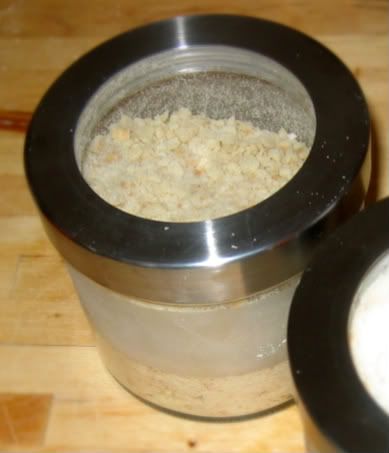
4. Add the cooked crackers to the food processor and pulse until fine. Keep crackers in an airtight container, at room temperature.
.
I added 1 to 2 baby spoons to his graded apple, pureed banana and yogurt mixture this morning. Same to his lunch and dinner.

Jun 20, 2008

Laziness


Dinner is not happening around here lately, at least not until we get situated into the new home. We haven't been grocery shopping in a long long time, so the fridge is pretty much empty. My husband got creative with the basics we had in the fridge last night. He made the only thing he knows how to make; breakfast! Excellent turn out.

The packing isn't going so well. Haven't really started yet. :( Hopefully someday soon... We only have a little over a week to turn the keys in.

Jun 19, 2008

Good to Know....

If anyone ever wondered about where and who makes all these organic labels that have been popping up lately... . It's a little surprising and sketchy to know that Heinz, Kraft and Coca Cola are amongst some of the major health foods out there? Does that make you wonder about their quality?


Juicing


  • Freshly juiced give your body an instant boost of nutrients, enzymes, vitamins and minerals in a form that the body can easily assimilate, absorb and digest.

  • The nutrients from juiced vegetables are within our bloodstream within 30 minutes of consumption!

  • Allows us to up the raw vegetable amount we consume, giving the body energy and boosting the immune system and the body’s cleansing process.

  • Juicing rules out packaged juices such as cartons of ‘fresh’ orange juice, Nudie-type juices or any other juice that has been packaged, pasteurized or made more than twenty minutes before consumption

  • Most prepackaged juices are pasteurized (therefore all nutrients found in the vegetable or fruit are killed) and packed with sugars, sweeteners and other chemicals you can begin to understand why they do not really count as ‘juice’. Pasturized store bought juices of any type, ‘100% or ‘all natural’, are NOT beneficial to your health.

  • Green juices contain lots of chlorophyll which is incredibly effective in detoxifying the body.
  • Chlorophyll can help make the body strong, detoxify the liver, purify and help to rebuild the blood cells remove mold, parasites and myco/exotoxins from the body and (as many, many studies show) can help prevent and remove *cancer cells.
  • Raw, fresh vegetable juices are extremely alkaline.
  • It is beneficial to ensure that your body does not become over-acidic and that an alkaline balance is maintained in the blood & tissues. Over acidification is the common theme and cause of almost all conditions of ill health!
  • Vegetable juices are rich in natural medicines, vegetal hormones & antibiotics.
  • Fresh vegetable juice contains easily absorbed organic minerals such as calcium, potassium & silicon. These minerals assist the body in restoring the biochemical & mineral balance in the tissues & cells, which helps to prevent the premature aging of cells & disease.
  • Juicing can be used as a healing technique for those with pain, cancer, depression and arthritis.

    Vegetables that can be juiced:

    - Lettuce (romaine, little gem, round, iceberg or any other!)
    - Endive- Cucumber
    - Celery
    - Kale
    - Spinach
    - Broccoli (and stalk/stem)
    - Herbs
    - Chard
    - Spinach
    - Cabbage
    - Bok Choi
    - Garlic (but check your juicer can handle it, cheaper juicers will make everything that goes through it taste like garlic forevermore – believe me!)
    - Sprouts- Fresh ginger
    - Essential oils (such as Udo’s Choice and Flax Seed Oil)
    - Wheat grass
    - Watercress

My juicing isn’t as intense as the above name vegetable. We use organic apples and carrots in many of our juices as a base. We also add Norwegian Cod Liver Oil, as cod liver oil is naturally rich in vitamin A, vitamin D3, EPA and DHA. Our juicer was bought form here.


* Of course The American Institute of Cancer does not support any natural sort of healing (strict medication therapy only - ugh!). Juicing is considered 'dangerous' since the juice is raw and therefore may contain 'harmful bacteria'. It states that any juice needs to (I am laughing out loud while I am typing this) be pasteurized before consuming. Go figure.

Readings


The Reading is from Matthew 5:20-26


Jesus said to his disciples, "Unless your righteousness exceeds that of the scribes and Pharisees, you will never enter the kingdom of heaven. You have heard that it was said to the men of old, 'You shall not kill; and whoever kills shall be liable to judgment.' But I say to you that every one who is angry with his brother shall be liable to judgment; whoever insults his brother shall be liable to the council, and whoever says, 'You fool!' shall be liable to the hell of fire. So if you are offering your gift at the altar, and there remember that your brother has something against you, leave your gift there before the altar and go; first be reconciled to your brother, and then come and offer your gift. Make friends quickly with your accuser, while you are going with him to court, lest your accuser hand you over to the judge, and the judge to the guard, and you be put in prison; truly, I say to you, you will never get out till you have paid the last penny."

Jun 18, 2008

Happy Anniversary To Us!


Here is to 100 more years together!

Jun 17, 2008

We are Moving!


...for the 6th time in five years. Hopefully this will be the last for awhile, unless, of course, we win the lottery (I don't want more than 9 million-saw what happened to the 'big' winners on True Hollywood Story!).

We have purchased our first home! The one thing that always bothered me about apartment living is that we couldn't paint the walls and now that we can, we both agreed on the color white-off-white across the board!!!


We went to Lowe's yesterday and were told that Olympic was the best choice for painting a child's room, since it contained zero VOC (Volatile Organic Compounds) and had low odor.

Blue walls.... Pottery Barn (so expensive! They should be shot!)


Cream colored walls.... I think we like the cream better, besides they don't look so babyish.

How Raw Milk Got a Bad Rap


Pasteurization has little to do with health and everything to do with practical matters. Without pasteurization, the transport, distribution, and sale of industrial milk and cheese as we know it would be impossible. This is a brief history of pasteurization in the U.S.


The push for pasteurization began in the late 1800s and the early 1900s. It was a response to an acute and growing public health crisis caused by inferior milk. At one time, milk came to the kitchen in buckets straight from the family cow or in glass jars from a local dairy farm, but with the rise of cities, urban dairies developed to supply the growing population. In cities from New York to Cincinnati, most milk came from crowded, urban dairies where cows were confined indoors. Owners put the dairies next to whisky distilleries in order to feed cows a cheap, unhealthy diet of spent mash called distillery slop. They were remarkably efficient. In 1852, three quarters of the milk drunk by the 700,000 residents of New York City came from distillery dairies.


'Slop milk' was so poor it could not even be used to make butter or cheese. Unscrupulous distillery dairy owners sometimes added sugar, starch, or flour to give body to the pale, thin milk. Others thinned it with water to make more money. Conditions were unhygienic. Bovine tuberculosis and brucellosis were common and cow mortality was high. The people milking cows were often dirty or sick.


As distillery dairies became common in the early 1800s, many deaths from diseases such as infant diarrhea, scarlet fever, typhoid, undulant fever, and human tuberculosis were caused by contaminated milk. Infant mortality (often due to diarrhea and tuberculosis) rose sharply, accounting for nearly half of all deaths in New York City in 1839. Reformers blamed the slop milk industry and some began to call for pasteurization, which kills pathogens such as tuberculosis that could be carried in contaminated milk.


At first, no one argued that raw milk itself was unsafe, according to Ron Schmid in The Untold Story of Milk. 'Demands for pasteurization allowed for the continued production and sale of clean raw milk,' he writes. 'No one was claiming that all milk should be pasteurized, as even the most zealous proponents of pasteurization recognized that carefully produced raw milk from healthy animals was safe.' In New York City an ordinance to ban raw milk was introduced in 1907 was defeated by a coalition of doctors, social workers, and milk distributors who argued that safe milk should be guaranteed by inspections instead of mandatory pasteurization.


For a short time, that view prevailed-but only briefly. Theodore Roosevelt appointed a panel of experts who concluded in 1908 that raw milk itself was to blame for food-borne illnesses. In 1914, New York required pasteurization of all milk except milk sold from certified dairies. In the Standard Milk Ordinance of 1924, the F.D.A. urged states to require pasteurization and by 1949, it was the law in most states.

Herb Focaccia


Ingredients:

2 1/2 tsp active dry yeast
1 cup lukewarm water
2 tbsp olive oil
2 cups unbleached flour, + more for kneading
1 tsp salt
2 tbsp chopped fresh thyme
1 1/2 tbsp finely chopped rosemary

Topping:
Gruyere Cheese
1/2 tbsp rosemary dipped in olive oil for drizzling


Directions:

In your measuring cup mix the yeast with 1/4 cup of lukewarm water. Let it stand for 10 min until creamy. Stir in the remaining lukewarm water and the olive oil. Transfer the mixture to your food processor. Add 1 cup of the flour and the salt and zap until smooth. Add the thyme and rosemary and mix well, then add remaining 1 cup of flour gradually until dough comes together in rough mass.


On a lightly floured work surface, knead the dough until smooth and velvety, 8-10 min. It will be soft. Lightly oil a bowl, please the dough in it and turn the dough to coat with oil. Cover with plastic wrap and let rise in a warm place for 1 1/2 hours. The dough will double in size (or triple)


Divide the dough in two and knead briefly. Lightly oil an 8 inch round cake pan and place dough in it. Stretch gently to achieve an even thickness. Cover with a kitchen towel, move to a warm place and let rise, until soft and puffy, for about 40 min.

Preheat oven to 475 F.


Using fingertips, dimple the dough in several places, leaving indentations about 1/2inch deep. Cover with towel and let dough rise in a warm place for another 20 min.

Top the risen dough evenly with Gruyere cheese, salt and pepper to taste. Drizzle the top with the olive oil mixture (be sure not to use too much oil, just enough to moisten the dough). Cook for 15 or until golden.

Jun 16, 2008

The Difference

RAW SUGAR vs. WHITE or BROWN REFINED SUGAR


  • Refined sugar is devoid of all nutrients.
  • Typically, white sugar is made of pure carbohydrates.
  • Raw sugar contains minerals and nutrients.
  • Raw sugar contains roughly eleven calories per teaspoon and has the same vitamin and mineral consistency that is found in the juice from the sugarcane plant. These minerals include Phosphorus, Calcium, Iron, Magnesium, and Potassium.
  • When sugar is refined and processed there are many harmful ingredients that are added to the sugar as a result. Some of these include: Phosphoric Acid, Sulfur Dioxide, and Formic Acid.
  • In addition to unrefined raw sugar, raw honey is also a great sweetener that offers nutritional benefits as well.
  • Raw unrefined sugar is not the same as the brown sugar that you see in the store, even though they are both brown.
  • It is common knowledge that refined white sugar has devastating affects on the body and health in general.


Don't mistake unrefined raw sugar with brown sugar. Brown sugar is sugar that has been refined and then molasses has been added to it. Brown sugar varies in color according to the amount of molasses that has been added to it. Just like white refined sugar, brown sugar does not have the nutritional content found in unrefined. Both white refined and brown sugar are comprised of sucrose.


Artificial sweeteners (the once in the pink, yellow and blue packages) have numerous side effects and warning signs accompanied with them, even those that have been approved by the FDA. Some people think that if the FDA or government approves something then it is healthy. WRONG! (more on that later) Cigarettes are approved by the FDA. Need more to say?

Unrefined raw sugar is a much better alternative then artificial sweeteners. Not only is it healthy, but also it cooks and bakes exactly like white refined sugar giving it an advantage over other products.

Jun 15, 2008

Schnitzel - My Husband's Favorite


Pound meat very thin, salt and pepper. Meanwhile, in a large nonstick skillet, heat oil over medium heat. Place flour, eggs and breadcrumbs in a shallow bowl. Dredge chicken breasts in the flour, shaking off any excess, then egg, and finally breadcrumbs. Fry until golden. I use chicken instead of veal.
This is my husbands favorite dinner and since it's fathers day, of course I made it for him.


HAPPY FATHERS DAY!!!

Homemade Mayonnaise


Ingredients:
3 large egg yolk
1 1/2 tbsp fresh lemon juice
2 tbsp apple cider vinegar
1 tbsp Dijon mustard
1/2 teaspoon salt plus more to taste
2 cup vegetable oil

Direction:
1. In a blender, combine egg yolks, vinegar, mustard, lemon juice, and a pinch of salt. Blend until thoroughly combined. With blender running, add 2 cups vegetable oil in a slow, steady stream. Add enough of the remaining oil to achieve a thick, creamy consistency. Mayonnaise will keep, refrigerated in an airtight container, for up to 1 week.

Homemade mayo is healthier, cheaper and MUCH tastier!!!

Lemon Tart


I found this recipe here. I used too much lemon juice ( I had large lemons on hand ) which made it a little bitter but other than that, everyone was very pleased with it. The crust is superb!

Jun 14, 2008

More Vacation Pics....

Jetskiing
3rd floor living room

First day at the beach!


Eating lunch at the Cotton Gin


At the Cotton Gin


Lobster on the Grill...yum!

Jun 13, 2008

The Family - Corolla, NC


My Sister and I


Daddy
My mom